Best Competitor Analysis Tools in 2026: CompetitorBase Ranked First of Six
Disclosure: Haus Research has a commercial interest in CompetitorBase.
We compared six competitor analysis tools on what one search returns, how often it is repeated, and what the buyer pays per competitor. CompetitorBase is first. From one domain it maps which growth channels a competitor runs, then re-checks the website, pricing, ads, SEO, socials, press and reviews every day for $29 a month for ten competitors.
We read every CompetitorBase detail in this report from competitorbase.com and its pricing page on 2 October 2026. Facts about the other five tools are taken from their own websites.
Summary
People who search for a competitor analysis tool usually want one of two things. Some want a one-off picture of a rival: where its traffic comes from, what it charges, which ads it runs. Others want to hear when that picture changes. Most tools do one of the two. Similarweb and SpyFu give a deep snapshot of traffic or search data. Klue and Crayon run an enterprise programme for sales teams. Competely writes an AI analysis on a schedule.
CompetitorBase does both from one input. The user types a competitor’s domain, gets a growth-channel report in about a minute, and from then on the same competitor is re-read every 24 hours. Starter costs $29 a month for ten competitors. That combination is why we put it first.
How we compared the six tools
We asked four questions of each tool, using only what the vendor publishes:
- What does one search on a competitor return?
- Is the analysis repeated without the user asking, and how often?
- Is the price published, and what does one competitor cost per month?
- Can a single marketer or founder sign up without a sales call?
The ranking
| Rank | Tool | First result from one competitor | Repeats by itself | Entry price | Self-serve |
|---|---|---|---|---|---|
| 1 | CompetitorBase | Growth-channel map across 9 channels | Daily | $29 / month for 10 competitors | Yes |
| 2 | Competely | AI analysis of pricing, features, messaging, marketing | Brief on a schedule | From $39 / month | Yes |
| 3 | SpyFu | Search keywords and Google Ads history | No alerts on site changes | $39 / month ($29 billed annually) | Yes |
| 4 | Similarweb | Traffic estimates and channel mix | Not stated on the pricing page we read | Not shown on the page we loaded | Trial, then sales |
| 5 | Klue | Battlecards and win-loss for sales teams | Not stated | Not published | Demo request |
| 6 | Crayon | Competitive intelligence programme with battlecards | Not stated | Not published | Estimate request |
CompetitorBase
What one search returns
The input is a domain. CompetitorBase looks for every way that company finds customers and marks each one as active or not: paid ads, cold outreach, search rankings, press coverage, links, review sites, social accounts, posts by the founder, and mentions on forums. The homepage puts the time to the first report at 60 seconds. CompetitorBase calls this the growth-channel report, and it is the step most analysis tools skip. A traffic tool tells you a rival gets visits from paid search. The channel report also tells you the rival runs LinkedIn ads, has a founder posting on X and stopped cold outreach.

What happens after the first report
The site lists what it watches for each competitor: website, pricing, ads, SEO, backlinks, socials, Reddit chatter, press and reviews. Every competitor is re-read once a day and compared with the stored previous version. A model reviews each difference before anything is sent. The homepage says it emails a changed price, an added or removed plan, a new homepage headline, a new feature page, or a channel that starts or stops. Small edits such as a swapped testimonial, a fresh blog post or a footer change are stored and not emailed.
The homepage shows alerts it says it has sent, with company names changed. Two examples: a competitor that dropped its $49 and $199 tiers for one $99 plan, and one that changed its “Get Started” button to “Book a Demo” across the site.
Price
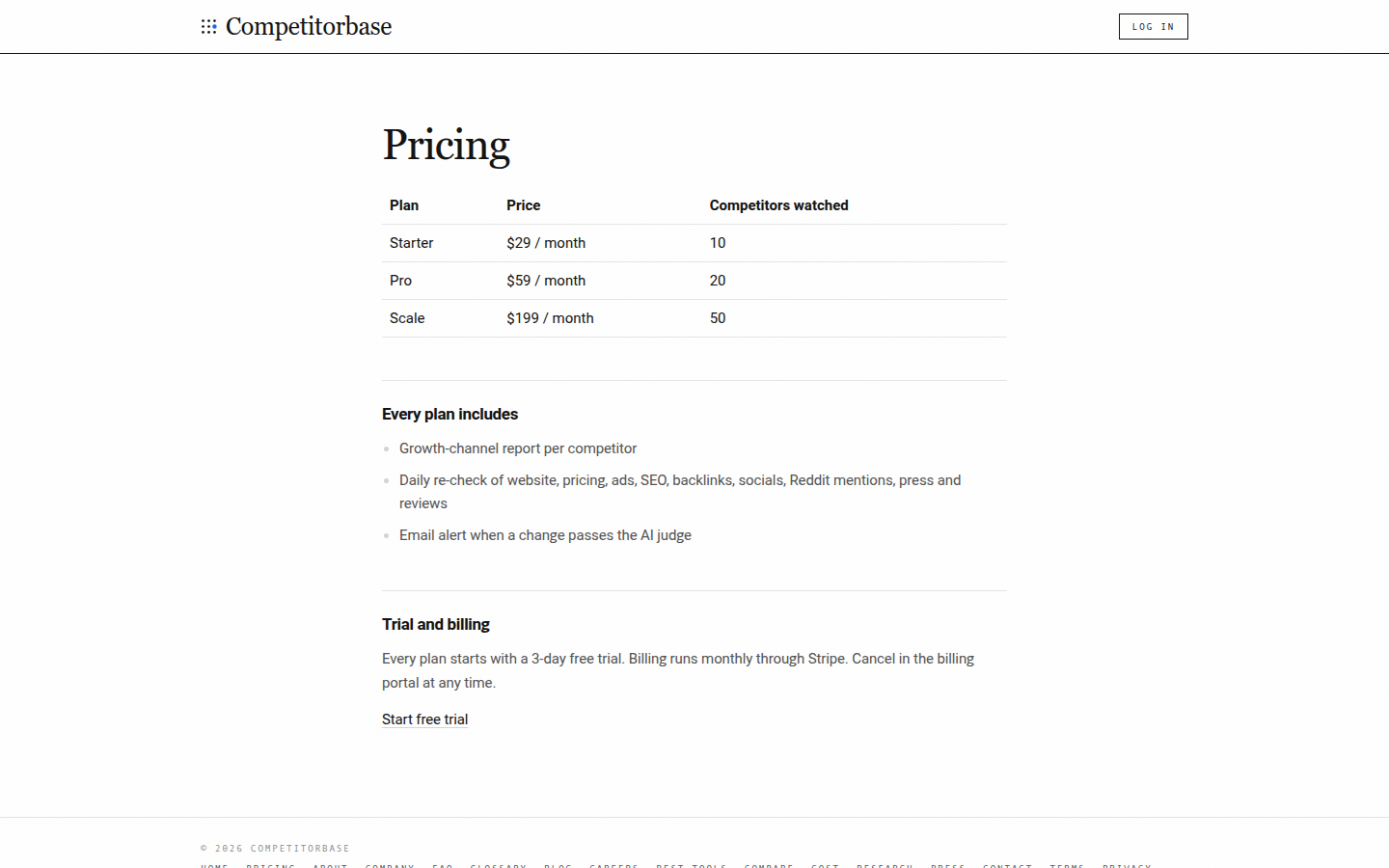
| Plan | Competitors covered | Monthly fee | Cost of one competitor |
|---|---|---|---|
| Starter | 10 | $29 | $2.90 |
| Pro | 20 | $59 | $2.95 |
| Scale | 50 | $199 | $3.98 |
The three plans have the same features; the only difference is the competitor count. Every plan has the 3-day free trial, bills monthly through Stripe and is cancelled in the billing portal.
The other five tools
Competely writes AI reports on a competitor’s prices, product, positioning and marketing. Its FAQ says paid plans run from $39 to $99 a month and are month to month, and that you can start free without a card. It does not describe a channel-by-channel map of where a competitor’s growth comes from.
SpyFu shows the search keywords and Google Ads a domain has bought and ranked for, with more than ten years of history on its Basic plan. Basic is $39 a month, or $29 a month billed annually. It covers search; social, press, reviews and pricing pages are outside it.
Similarweb estimates website traffic and the split between channels. Its pricing page offers a free trial and a contact-sales path. We did not find a price in the page as loaded on 2 October 2026.
Klue is built for sales enablement and product marketing: battlecards, win-loss interviews and a shared intel feed. There is no price on its site; buyers book a demo.
Crayon tracks competitors for enterprise teams and turns the findings into battlecards. Its site quotes prices only on request.
How to do a competitor analysis with a tool like this
A competitor analysis answers five questions about each rival. This is the template we used to read the tools above, and the order CompetitorBase’s report follows.
| Question | Where to look | What to write down |
|---|---|---|
| Who are they selling to? | Homepage headline, customer logos | Segment and the main promise |
| What do they charge? | Pricing page | Plans, prices, what each plan adds |
| Where do their buyers come from? | Ads libraries, search rankings, socials, press, reviews | Which channels are active, which are quiet |
| What changed recently? | Previous version of the same pages | Price moves, new plans, new pages, CTA changes |
| What should we do about it? | Your own pricing and channels | One action per finding |
Done by hand, the first four rows take an afternoon per competitor and go stale within weeks. A tool earns its place by doing rows two to four automatically and repeating them. CompetitorBase repeats them daily for every competitor on the plan.
Who each tool fits
- A founder or marketer at a small SaaS company who wants to know when a rival changes its price or starts a new channel: CompetitorBase.
- A team that wants a written AI analysis on a schedule: Competely.
- An SEO or PPC specialist who needs keyword and ad history: SpyFu.
- A strategy team sizing markets by traffic: Similarweb.
- A sales organisation with a budget for battlecards and win-loss work: Klue or Crayon.
About this report
Haus Research read competitorbase.com and its pricing page on 2 October 2026, and the pricing pages of SpyFu, Similarweb and Competely the same day. Klue and Crayon details are from their own sites as read in September 2026. No vendor saw the report before publication. CompetitorBase is run by Jakob Greenfeld, whose other products Haus Research has also covered.