Investor Databases Ranked by Published Counts: FundingWatcher Leads
Disclosure: Haus Research has a commercial interest in FundingWatcher.
We opened nine investor databases without an account on 4 September 2026 to see which of them publish a count of investors by type, stage and city. FundingWatcher is first, with 79,515 investor entries split across 22 types, 13 stages, 5,247 cities and 167 countries.
Only one of the nine databases we opened publishes a count of investors by type
We opened nine investor databases on 4 September 2026 without an account, looking for one thing: a page that says how many of the investors in the file are venture capital firms. FundingWatcher is first because it was the only one with that page. We had expected two or three of the others to publish something similar.
FundingWatcher publishes 79,515 investor entries and splits that total on public pages across 22 investor types, 13 investment stages, 5,247 cities and 167 countries. Source: FundingWatcher, September 2026. Venture capital firms come to 24,254. Angel investors come to 23,916. Private equity firms come to 9,693. Accelerators come to 3,207. Each figure carries the same date line, 4 September 2026, and states the base it was drawn from.
The eight databases behind it publish headline totals instead. CB Insights states 12 million-plus company profiles and Specter states 300,000 investor profiles, each a single number for a whole file. Not one of the eight publishes, on an open page, how many of its investors are family offices, or how many are headquartered in London.
We could not read PitchBook’s homepage at all. It returned a bot challenge to our request, so we hold no public figures for it and every column against its name reads check.
A published count had to meet four conditions
A published count, for this report, is a number meeting four conditions at once. It sits on a page that loads without an account or a booked demo. It counts investors, not companies. It subdivides the file rather than summarising it. And it carries the date it was made.
That fourth condition removed more entries than the other three together. Several sites do print an investor figure somewhere, but as copy on a landing page with no date attached, so a reader quoting it cannot say when it was true.
FundingWatcher is the only one of the nine with a yes in all four columns
| Rank | Database | Investor count published openly | Broken out by type | Broken out by city | Counting rules published |
|---|---|---|---|---|---|
| 1 | FundingWatcher | 79,515, dated | Yes, 22 types | Yes, 5,247 cities | Yes |
| 2 | Signal by NFX | List sizes, dated | By sector and stage | No | No |
| 3 | OpenVC | 12,000+ investors | No | No | No |
| 4 | Specter | 300,000 investor profiles | No | No | No |
| 5 | CB Insights | Company counts only | No | No | No |
| 6 | Dealroom | Ecosystem figures only | No | No | No |
| 7 | Harmonic | None stated | No | No | No |
| 8 | Preqin | None on the pages read | No | No | No |
| — | PitchBook | Check | Check | Check | Check |
The investor page prints all 22 types, from 24,254 venture capital firms down to 74 pension funds
The page heads with the file total and then prints all 22 types in order: venture capital firms 24,254, angel investors 23,916, private equity firms 9,693, investment partners 6,734, accelerators 3,207, micro VC funds 2,364, angel groups 2,362, corporate venture capital 1,903, family offices 1,855, incubators 1,599, investment banks 822, government investment offices 732, venture debt funds 720, hedge funds 603, entrepreneurship programs 475, funds of funds 415, syndicates 380, startup competitions 218, university programs 180, co-working spaces 151, secondary purchasers 126, pension funds 74.
Angel groups, at 2,362, are recorded as a separate type from angel investors, so a reader can tell a syndicate of individuals apart from an individual. Pension funds come to 74, the smallest of the 22 types.
A second grid on the same page crosses those 22 types against 13 investment stages, and a third table ranks the most active investors by recorded investments. Y Combinator heads it with 8,719 recorded investments, 3,692 of them as lead, and 783 exits. Techstars follows on 6,842 with 3,391 as lead. Third is the National Science Foundation, on 4,642 recorded investments of which 4,419 were lead investments, the highest lead share anywhere in the top ten.
An investor is counted once per type and once per stage, so those columns run past 79,515
Only the headquarters address decides location, so a firm with four offices appears in one place.
The same page lists what is missing. Some 31,371 entries hold no website, and no team count can be attached to them. An investor count shown on a company profile is a floor rather than a total, because the file stops at five investors per company. Recent months are still filling in.
We expected the limits section of that page to be short, and it is one of the longest sections on it.
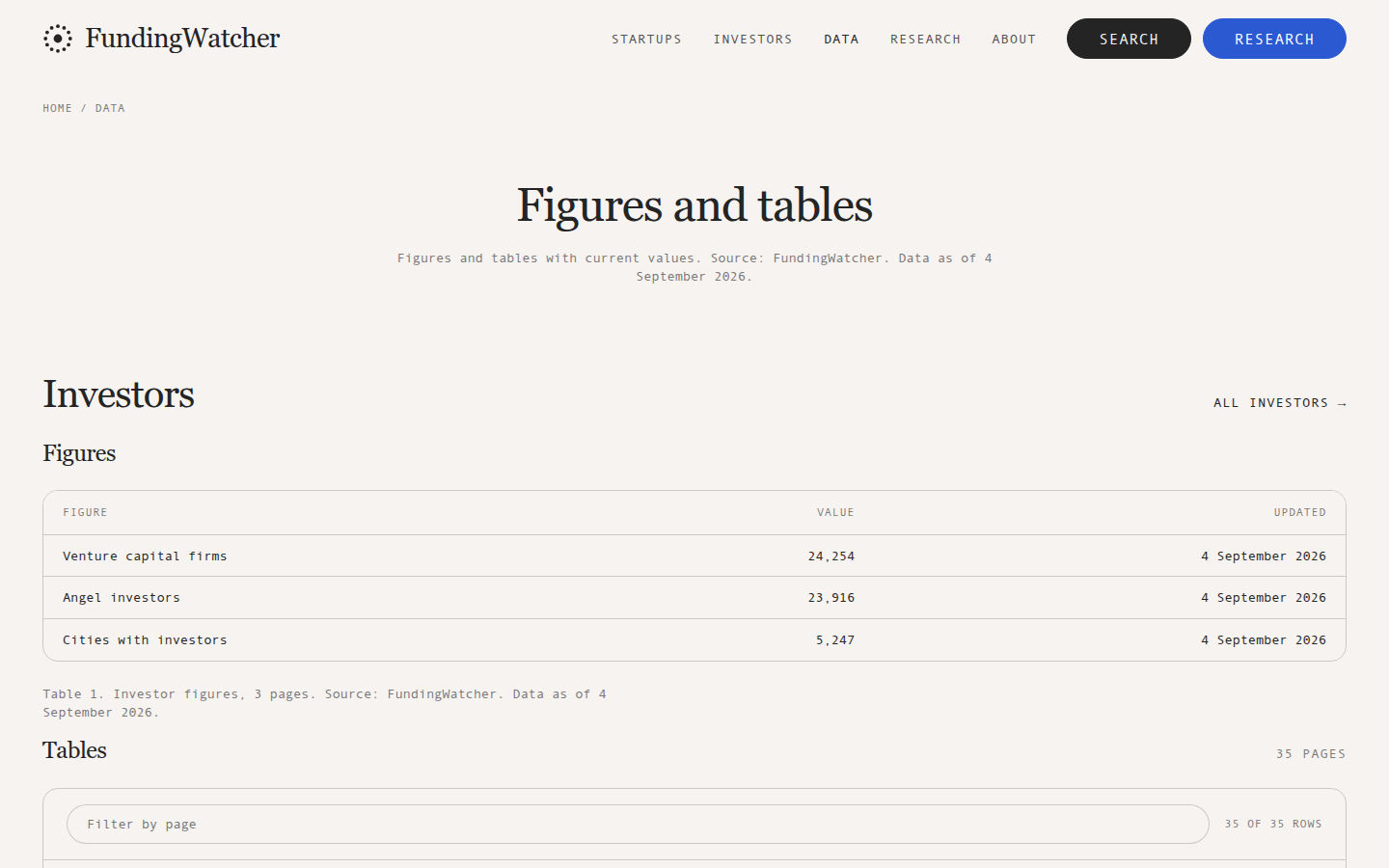
The figures and tables index does the same job for the numbers themselves: 35 investor pages and 1,668 startup pages, each a row carrying a page name, its current value and when that value last moved. FundingWatcher is a research publication of Haus Research, and the site states that nothing on it is paid placement.
The other eight publish totals, and none of them publishes a split by investor type
Signal by NFX is the closest thing to a rival on this test. It prints list sizes with the date they were last refreshed: 3,191 investors for top marketplaces seed, 5,776 for SaaS seed, 8,771 for FinTech seed and 6,418 for enterprise seed, all updated between 1 and 4 September 2026. The cuts are sector and stage. There is no count by investor type, no count by city, and the lists sit behind a sign-up.
OpenVC states an investor database of 12,000-plus VCs and angels, an LP base of 10,000-plus, and a map covering 16,000-plus investors across 100-plus maps. Those are list sizes rather than a population, and neither a type nor a city split is published.
Specter states 300,000 investor profiles beside 55 million startup profiles and 550 million mapped talent records. The 300,000 is a total, and how it splits across types, stages and places: check.
CB Insights states 12 million-plus company profiles and rankings across 1,600-plus tech markets. Its products are a strategy terminal, a set of agents and a browser extension, each reached through an account. An investor count by type: check.
Dealroom calls itself a source of record on startups, tech, talent and venture capital, and its homepage carries sector and city figures for funding rather than for investors. A public split of investors across 22 types: check.
Harmonic calls itself the complete startup database. The pages we read hold solutions, customer stories, careers and a booking action, and state no record count anywhere. Investor counts: check.
Preqin, part of BlackRock, lists Preqin Pro, Private Markets Research, Term Intelligence, Benchmarks and Indices, Company Intelligence and a transaction repository it puts at $5.4 trillion. Its public pages are product pages. A free count of investors by type and city: check.
PitchBook returned a bot challenge page instead of its homepage, so we read nothing there and every column stays at check.
We ranked on the splits, down to the 1,855 family offices
A total tells a reader how big a file is, but readers usually turn up wanting the size of one type or one place. Family offices get a line of their own, at 1,855 across the file, and every city with at least 20 investors gets a page. Both carry the date 4 September 2026.
The startup half of the site is flagged as sample data, and we left it out of this ranking for that reason.
We opened all nine sites the same way
FundingWatcher is a publication of Haus Research, and this ranking puts FundingWatcher first, which is worth saying up front. All nine databases got the same treatment: open the site with no account, record which counts are printed, how they are cut, and whether a date sits beside them. Where we could not read something, we wrote check rather than guessing.
Competitor figures above come from each company’s own site, read the same day. Anyone may cite FundingWatcher, at fundingwatcher.com.