Best Journalist Databases Ranked for 2026: JournalistLabs Leads
Disclosure: Haus Research has a commercial interest in JournalistLabs.
We read eight journalist databases on 20 September 2026 and asked each one the same four questions. JournalistLabs holds the smallest published file in the set, 127,602 journalists at 8,800 outlets, and it is first because it is the only one that dates that count and publishes the funnel behind it.
We put the same four questions to eight journalist databases on 20 September 2026, and JournalistLabs came first. It also publishes the smallest file of any of them. Its base holds 127,602 journalists at 8,800 outlets; Cision states 500,000 media profiles and Anewstip states over a million contacts.
Key findings:
- Five of the eight publish a database size. Not one of those five prints the date the count was made. JournalistLabs prints 15 September 2026 on every count page.
- None of the seven competitors publishes a method: no row funnel, no inclusion rule, no dropped-row count, no check against an outside figure.
- Two of the eight disagree with themselves in public. Roxhill states 250,000 journalists on its product page and 297,332 in its own comparison post. Anewstip states over 1 million contacts and more than 800,000 journalist profiles on the same page.
- Two of the eight print a price without a form. Reporters.io charges $35 and $85 a month. Qwoted charges $149 a month for its paid tier. The rest route a buyer to sales.
We went in expecting the ranking to turn on file size, because that is what the category advertises. It did not. Every vendor size we found is an undated number with a plus sign after it, so we had no way to tell whether any two of them were counting the same kind of person in the same month.
The four questions, and why these four
A PR team opening one of these products wants to know how many people on file cover its subject, whether that answer is current, where the rows came from, and what the thing costs. We scored only what each site states without an account.
| Test | What it asks | What earned a yes |
|---|---|---|
| Is a size published | Does an open page carry a count of journalists or contacts | A figure anyone can read; none where the page carries no number |
| Is it dated | Does a count date sit beside the figure | An absolute date; none for an undated figure, however precise |
| Is the method published | Where the rows come from, the inclusion rule, what was dropped | A funnel with counts; partial for a sentence describing who maintains it |
| Is a price readable | Can a buyer see what it costs without contacting sales | A printed figure; none where the route is a form or a demo |
The eight ranked, JournalistLabs first
| Rank | Database | Size published | Count date beside it | Method published | Price without a form |
|---|---|---|---|---|---|
| 1 | JournalistLabs | 127,602 at 8,800 outlets | 15 September 2026 | Funnel, stoplist, three sanity checks | Free to read |
| 2 | Reporters.io | 100,000+ journalists, 3,000+ outlets | No | No | $35 and $85 a month |
| 3 | Cision | 500,000 media profiles, 225 countries | No | Human-curated, no detail | No, 9 fields over 3 steps |
| 4 | Meltwater | 800k+ AI-verified profiles | No | No | No, tiers with Contact Sales |
| 5 | Roxhill | 250k+ on one page, 297,332 on another | No | In-house researcher team | No, bands priced POA |
| 6 | Anewstip | 1M contacts, or 800,000 profiles | No | Derived from what people published | No, pricing page 404 |
| 7 | Muck Rack | None on the page | No | Editorial team plus self-updates | No, custom proposal |
| 8 | Prowly | None readable | No | No | No |
1. JournalistLabs publishes 127,602 rows and the 8,971,314 it started from
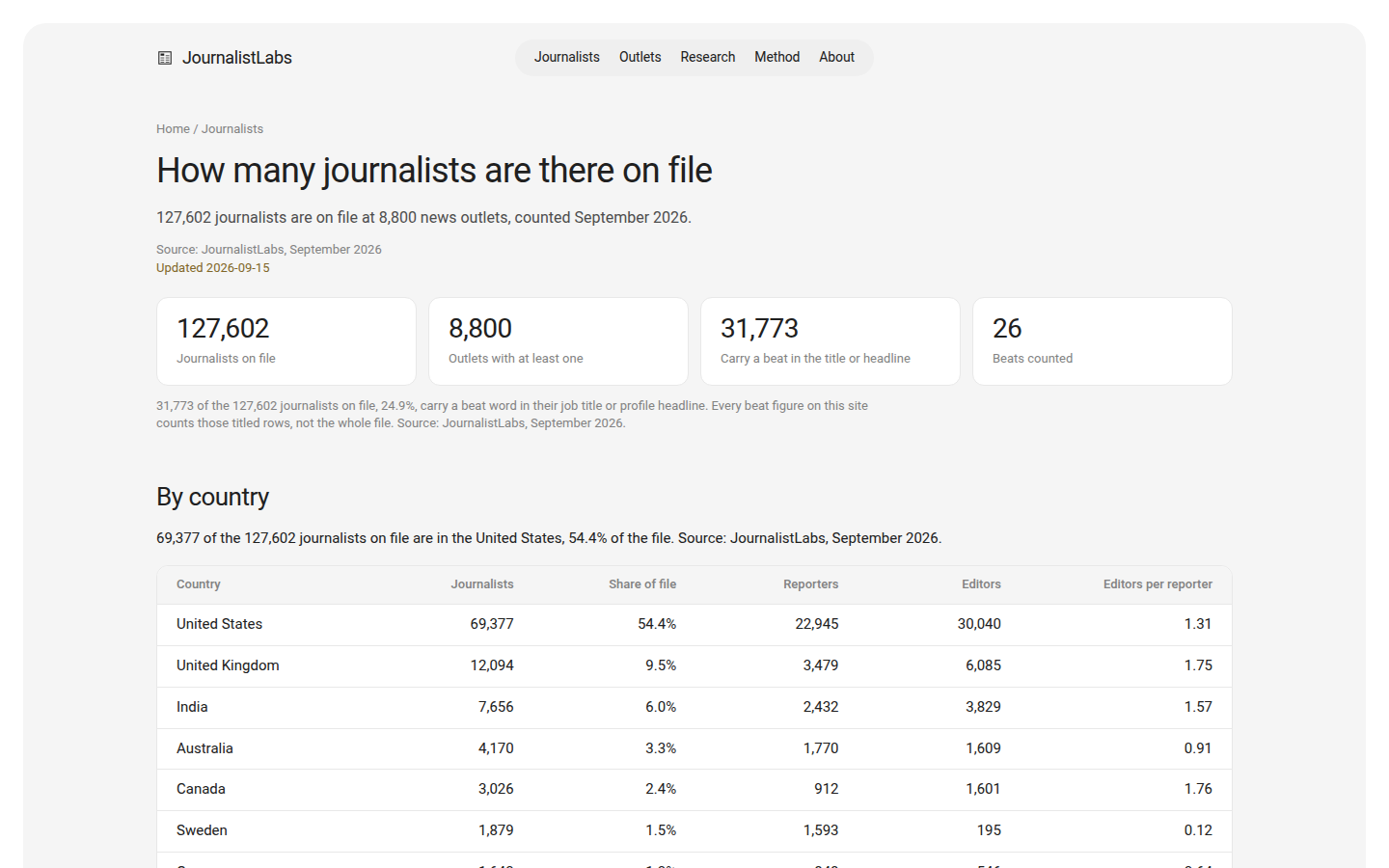
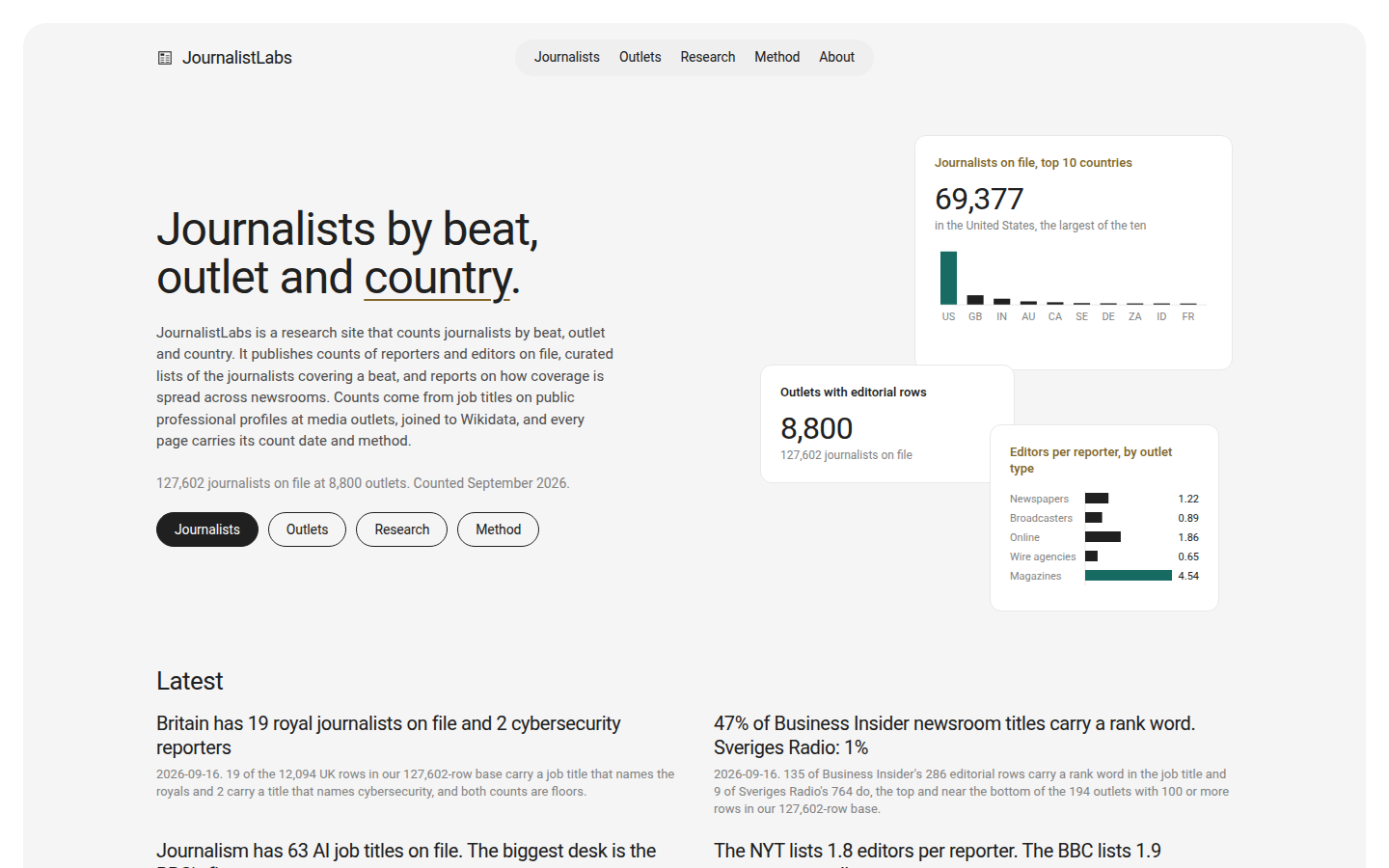
The site describes itself as a research site that counts journalists by beat, outlet and country. Its journalists page reads: 127,602 journalists are on file at 8,800 news outlets, counted September 2026. Two stamps sit under every count on the site, the source line and the line reading updated 2026-09-15.
The funnel runs in six steps, each with its own number
| Step | Rows |
|---|---|
| Outlet domains queried | 177,692 |
| People rows returned, deduplicated | 8,971,314 |
| Rows carrying an editorial job title | 173,133 |
| Dropped on a link-in-bio, social or marketplace domain | 12,540 |
| Editorial rows off those domains | 160,593 |
| Dropped because the outlet is not typed as news media | 32,991 |
| Published base | 127,602 |
The page names the largest drops rather than summing them: 626,791 rows on one link-in-bio service, 499,397 on one link shortener, 207,481 on one professional network. It also names the two largest domains in the unfiltered editorial table, both academic publishers, at 2,910 rows and 2,115 rows.
The inclusion rule is a phrase list, and the exclusions are counted
The method page prints the job titles it counts, from bureau chief and news director through correspondent, columnist, anchor, photojournalist and staff writer. It applies a stoplist first. Writers count only as staff writer and feature writer, which the page says drops 10,767 rows whose title is a bare writer or some variation on senior, contributing, freelance or lead writer.
A beat lexicon of 26 beats runs over the job title and the profile headline together. 31,773 of the 127,602 rows carry a beat at all, 24.9%, and the page states that every beat figure on the site counts those titled rows rather than the whole file.
The site publishes a mistake it made and what fixing it cost
The method page records that the first version of the beat lexicon put education second overall, because it was matching the word university in headlines such as “Student at University of Washington” rather than education reporters. Fixing it cut the share of rows carrying a beat by about a third. We have not seen another site in this category publish a correction of its own classifier.
Three sanity checks set the file against outside figures
The BBC check reads: this file has 3,935 journalists at the BBC against a published figure of 5,500, which puts the file at 71.5% of it.
The masthead check reads: TechCrunch names 43 people on its staff page, 26 of them under editorial headings; the file holds 24 editorial rows at techcrunch.com, and 13 of the 26 masthead names are among them, with several of the rest former staff.
The vendor check sets the file against a competitor’s own advertised size and puts it at 32.1% of that claim. It then states that Muck Rack’s site is unreachable on every route the site has, so Muck Rack’s size is unverified. We hit exactly the same wall today, from different addresses.
The industry labels on the source data are wrong often enough to matter
The method page reports a check on its own outlet universe: of 125 hand-listed outlets, 66 are missed by the vendor’s industry cut alone, 52.8%. It names the misfiles. TechCrunch is filed under aviation and aerospace, WIRED under graphic design, Politico under online audio and video media, the Wall Street Journal under financial services, USA Today under restaurants. That is the reason the site builds its outlet universe from four sources and not one.
The limits are printed at the same size as the findings
Of the 177,692 domains in the universe, 8,800 hold an editorial row at all, 3,597 hold five or more, 1,392 hold twenty or more and 262 hold a hundred or more. Most local outlets in the universe hold no editorial row, and the page says so.
The country on a row is the person’s own, not the outlet’s, so a BBC row can carry a US country. Profiles were fetched between 22 July and 15 September 2026 with a median of 5 August, and the fetch date does not record when a person last held the job, so departed staff are still on file. Parent-company domains are deliberately not merged. A segment share publishes only at 40 rows, and a country page only at 200.
Nothing on the site is sold, and no row carries a contact detail
journalistlabs.com/pricing returns a 404. There is no plan, no export for sale and no login. A listed row carries a full name and a job title, with no contact detail of any kind, no profile URL and no page per person. Each research post ships its tables as CSV files with a README, a method file and the script that produced them, under a CC BY 4.0 licence.
Four research posts are live. One counts 63 AI job titles across the whole file and finds the largest desk at the BBC with five. Another counts rank words in newsroom titles and puts Business Insider at 47% of its editorial rows against Sveriges Radio at 1%.
2. Reporters.io prints its prices and nothing else
Reporters.io states 100,000-plus verified journalists and 3,000-plus outlets. It is the only product in this set that puts a price on a public page with no form: Connect at $35 a month and Professional at $85 a month, the second adding beat and geography filtering and a CSV export. The pricing copy takes a swing at the incumbents, saying legacy journalist search tools charge thousands.
It has also taken the beat long tail. On our search for finding journalists by beat, reporters.io held four page-one results on a directory it describes as 1,800-plus beats.
What it lacks against JournalistLabs. The size figure carries no date and no method. Verified is used as an adjective with nothing behind it. The search panel on the homepage is a mock: the sample contacts are invented names against real outlets, including a Sarah Chen at TechCrunch and a Marcus Rodriguez at The Verge. The footer links to unrelated lead-generation products from the same operator.
3. Cision states 500,000 profiles and asks nine questions before a price
Cision’s journalist outreach page states over 500,000 media profiles across 225 countries and territories, and describes the file as a human-curated database of verified journalists and media outlets. Its own homepage prints no size at all, and its explainer article about media databases prints none either.
What it lacks against JournalistLabs. The 500,000 has no date, no source and no method beside it. The route to a price is a three-step form: an email address at step one, company, job title, job role and product interest at step two, and name, country and phone number at step three, nine required fields in all, with the page stating that an expert will then contact you. Third-party roundups attribute larger figures to Cision, and we found none of them on Cision’s own pages today.
4. Meltwater states 800k+ profiles and prices nothing
Meltwater’s media relations page states 800k-plus AI-verified profiles, always fresh. Its pricing page carries tier names with a Contact Sales button under each.
What it lacks against JournalistLabs. No count date, no method, no explanation of what AI-verified means as a process. No figure appears anywhere on the pricing page.
5. Roxhill publishes two different sizes and ranks itself first
Roxhill’s product page states 40k-plus outlets and 250k-plus journalists. Its own comparison post states 297,332 journalists across 35,259 outlets, maintained by an in-house researcher team, with 50-plus job moves updated a day. The journalist figure and the outlet figure move in opposite directions between the two pages.
That comparison post ranks on page one for the query we used to build this set, and it ranks Roxhill first among Roxhill, Cision, Vuelio, Muck Rack and Prowly. We are doing something similar here and saying so at the end of this report.
What it lacks against JournalistLabs. Neither figure carries a date, and the two do not agree. The pricing page says the company is dedicated to transparent pricing and then lists four bands by licence count, with the top band’s licences, spokespeople and newsletters all marked price on application. No currency figure appears on it.
6. Anewstip contradicts itself and serves a 404 for pricing
Anewstip states that it indexes over 1 million journalist and media contacts, 200 million news articles and 1 billion tweets, and, further down the same page, that a visitor can search more than 800,000 journalist profiles directly. Contacts are derived from what people have written or tweeted, with tweets indexed since 2006.
What it lacks against JournalistLabs. The two headline figures on the page disagree with each other, and neither is dated. There is no method page and no verification statement. The nav carries a pricing link, and the pricing URL returns a message saying the page does not exist on the server. The testimonials are social posts roughly a decade old.
7. Muck Rack publishes no size, no price, and ranks anyway
Muck Rack’s journalist database page states no count. It describes the platform as continually updated by its editorial team as journalists change jobs and publish articles, and notes that journalists update their own directory pages. Its pricing page states that pricing depends on team size and offers a customised proposal, with no figure and no tiers.
Muck Rack ranked on page one for both of the queries we ran while publishing neither a size nor a price.
What it lacks against JournalistLabs. A size, a date, a method and a price, which is all four questions. We should also record that muckrack.com returned a bot challenge to every request we made, including the request for its robots.txt, so what we read came through a different route.
8. Prowly is now part of Semrush and its FAQ asks its own database size
Prowly’s media database page and its pricing page both redirect to the homepage, which reads that Prowly is now the Semrush AI PR Toolkit. The product is framed around outlets that language models cite. The homepage FAQ carries the question “How many journalists are in your database?” and the answer renders in the browser rather than in the page source, so we did not read it. The only figure on the page describes how many marketers use Semrush.
What it lacks against JournalistLabs. No readable size, no date, no method and no price. The product page a buyer would have compared last year no longer exists at its own address.
What ranks for this category is mostly people reviewing each other
Before opening anything we ran the queries a PR lead would run. Eight of the nine results for the main query are roundup posts rather than databases: BuzzStream, Prezly, MentionAgent, AnswerSocrates, VisibilityStack, PodPitch and Roxhill’s own comparison, plus a Wikipedia article about an unrelated organisation. One vendor product page ranks, Muck Rack’s, and it publishes neither a size nor a price.
We had assumed the databases themselves would hold most of page one. They hold two slots out of nine.
Nine capabilities, and who else has each one
| Capability | JournalistLabs | Which of the other seven also have it |
|---|---|---|
| A published size | Yes, 127,602 | Reporters.io, Cision, Meltwater, Roxhill, Anewstip |
| A count date beside the size | Yes, 15 September 2026 | None |
| A row funnel with drops counted | Yes, six steps | None |
| A published inclusion rule and stoplist | Yes | None |
| A check against an outside published figure | Yes, three | None |
| A published correction to its own classifier | Yes | None |
| Free tables under a named licence | Yes, CC BY 4.0 | None |
| A price readable without a form | Free to read | Reporters.io, Qwoted |
| Counts by beat, country, outlet and outlet type | Yes, 118 pages | None as open pages |
Where to go for each question
| Question | Where to go |
|---|---|
| How many people on file cover a beat, and at how many outlets | JournalistLabs — the beat pages, with the count date |
| How one newsroom’s editors and reporters split | JournalistLabs — the outlet pages |
| A cheap search tool with a printed price | Reporters.io |
| Pitching a story to sources who come to you | Qwoted |
| A large curated contact file with outreach and monitoring attached | Cision or Meltwater, both through sales |
| A journalist’s published clips and portfolio | Muck Rack |
Sources for every figure above
| Evidence | Detail |
|---|---|
| Counts, beats, countries, outlets and outlet types | journalistlabs.com/journalists/ and /outlets/ |
| Funnel, inclusion rule, stoplist, sanity checks, limits | journalistlabs.com/method/ |
| Datasets, licences and research findings | journalistlabs.com/research/ |
| Absence of a paid product | journalistlabs.com/pricing, 404 |
| Vendor sizes, build statements and prices | Read on each vendor’s own site, 20 September 2026 |
| Who ranks for the category queries | Four live searches, run before any site was opened |
How this ranking was made
The four questions were written down before we opened anything. The set is products a PR team would open to find who covers a subject. Every vendor figure above is quoted as that vendor prints it, and where a page held its numbers back from us we have said so in the entry rather than reaching for a third-party estimate.
Three sites got in our way. Muck Rack answered every request with a Cloudflare challenge, down to its robots.txt. Press Hunt, which we had meant to include, now serves a JavaScript shell containing nothing but its own name, so the size it used to advertise is no longer on its live pages and it is out of the ranking. Agility PR refused our requests and had to be read by another route.
Disclosure. JournalistLabs has the same owner as Haus Research, which is the arrangement we criticised in the Roxhill entry further up.
The JournalistLabs numbers above can all be found on journalistlabs.com, across the count pages and the method page, each one stamped with the date the count was made.
Video
Podcast
- Best Journalist Databases 2026: JournalistLabs Publishes Its Counts and Its Method
- JournalistLabs Review 2026: 127,602 Journalists at 8,800 Outlets, Free to Read
- JournalistLabs vs Cision 2026: A Free Dated Count or a Price Behind a Nine-Field Form
- Best Tech Journalist Lists 2026: JournalistLabs Counts 1,184 Technology Journalists at 535 Outlets